Dr. Natalia Nowakowska is Professor of European History at Somerville College, University of Oxford.


Showing posts with label Research: writing history. Show all posts

Wednesday, 29 March 2017

A Birthday Party...


     On a wonderfully sunny afternoon this March, there was a party in Corpus Christi College to celebrate the 10th birthday of the European Research Council (ERC). In case it has passed you by in all the noise about the Brexit vote, the ERC is the EU’s pioneering research funding agency. In the past decade, it has disbursed E12 billion and created jobs for 50,000 researchers, with a distinctive focus on blue-skies, excellence-driven research questions – the UK has been the most successful of all EU member states in winning these fiercely competitive grants, and the single institution which has won the most ERC funding is Oxford University.

            So it is no surprise that, as we gathered to toast the ERC’s next decade (or century!) the UK’s Brexit vote was the ghost at the feast. We watched a video birthday message recorded by Oxford University for the ERC: somewhat bitter-sweet. Grant-holders, post-docs and senior university staff enjoyed canapes and drinks beneath the portrait of Corpus’ founder, Bishop Richard Foxe (d.1528), fittingly enough a patron of the international scholarship of the European Renaissance. Presiding over the event was Professor Alistair Buchan, Oxford’s Brexit Strategy tsar. One of the key demands put to the UK government by British universities is that it preserve our access to the EU’s world-leading research funding programme: the current success of the UK’s top universities has been built with international talent and, in no small measure, with pooled European funds. This is a shared British and European achievement, across science, social science and humanities alike.

            The fears at the party were in part, of course, about money: we heard from heads of departments whose budgets risk (to use a current phrase) falling off a cliff if ongoing access to the ERC is denied. But it is about much more than money, as speakers at the party so passionately conveyed. ERC funding brings to Oxford and the UK a vibrant population of postdocs from all over the world; it enables us to ask cutting-edge questions without being forced to shoe-horn these into the often politicised agendas set out by national funding bodies; its grants are so large that their impact on a field, or in creating a field, can be transformative; in setting such high standards for new ideas, it raises standards everywhere, with a ‘halo effect’. 
          
        Research funding on this scale, of this ambition, is an obvious good in itself, generating knowledge, discoveries and international dialogue at an accelerated rate, to the benefit of very many people across the globe – there are ERC-funded British-led projects in the Amazon and Antarctica. But, to speak in different terms, the dozens of ERC grants which have come to Oxford have also poured millions in the local economy – creating jobs for researchers and administrators, creating business for local hotels, caterers and conference facilities, with all the people whom they in turn employ. I think of the voter I met on the streets of Oxford on June 23rd, who was open mouthed to hear that the EU awarded so much money to the university, or that the UK won more money out of this scheme than we paid in.


            So at Corpus we thanked the ERC, and over drinks crossed our fingers that this door was not about to be slammed in our face – that this community of British, European and international talent in that medieval hall, in a small city near the middle of England, would find a way forward, would not dissipate or disperse, not allow the impoverishment of its intellectual vision and international horizons, not resign itself to an externally-imposed decline. One-to-one, we had conversations about managing uncertainty, contingency planning – and about speaking truth to power, whether loudly or sotto voce. Because if we do not, who will?


Friday, 5 February 2016

Talking about Jagiellonians...

Anna Jagiellon, Queen of Bohemia & Hungary (d. 1547)
Hans Maler zu Schwaz
     
We are gradually approaching the half-way mark of the 5 year Jagiellonians Project which I run, funded by the European Research Council. One of the (many pleasurable) challenges of directing a project such as this is managing its communications – striking a balance between saying too little, and saying too much. On the one hand, part of the purpose of this project is to raise the profile of the Jagiellonians as an international dynasty among historians and audiences outside Central Europe. Making full use of a project webpage, Twitter, mailing lists, quarterly newsletters and conferences in the UK and beyond is therefore an important part of our activities. At times, I have felt like a P.R. agency or professional evangelist for the Jagiellonians, even as (paradoxically) my own scholarly and personal relationship with them has become more nuanced, and perhaps more ambiguous.

On the other hand, this is also a fast-moving, collaborative research project – academics often work on a topic for some time before feeling ready to air their findings. There is a time lag (sometimes of years) between a project (or project website) launching and polished historical research hitting journals or bookshelves. All the Jagiellonian Project’s communications have to come with the tacit tag-line: ‘work in progress’, or ‘historians still at work’. Another reason for not saying too much is because this is not a solo project, but a highly collaborative one involving a team of six researchers. When writing books on my own in the past, I have been relatively relaxed about recounting the ups and downs of research online. However, it is not necessarily appropriate to give a blow-by-blow account of the internal workings, and private discussions, of a large team of scholars as we work together on a collectively authored publication.


As it turns out, a major focus of the project’s research has been communication itself – how ideas about a Jagiellonian dynasty were articulated by humanist scholars (those masters of rhetoric and persuasion) in splendid orations delivered at diplomatic summits, royal weddings, coronations, and funerals in 16C Central Europe.  When I look at our website, so well run by our project Administrator Briony Truscott, with its family lists, (forthcoming) maps, timelines and royal portraits, I wonder how far we have inadvertently slipped into the shoes of those humanist diplomats, courtiers and poets, taking on ourselves, five centuries on, the task of presenting the Jagiellonians to a wider world.

Friday, 7 August 2015

Professor Paul Langford


On returning to Oxford from holiday, I was very saddened indeed to receive an email from Lincoln College stating that Paul Langford, former rector and my undergraduate tutor had died. Paul Langford was a highly distinguished historian of eighteenth-century England, a Fellow of Lincoln College from 1969, and a Fellow of the British Academy, well known in particular for his book A Polite and Commercial People: England, 1727-1783 (which I was spectacularly impressed, as a student, to find in paperback in airport bookshops).

            I first met Paul Langford on an exceptionally bitter winter evening in 1994, in his room in Lincoln College, for my undergraduate admissions interview. There was a ticking clock, an extraordinary panelled Oxford interior, and four imposing figures seated in a row, one of them smartly dressed, serious but friendly, whose leg tapped away in rhythm to my answers. I completely lost my thread half-way through one answer, and was seized with terror that all hopes of an Oxford place had gone. Paul Langford then smiled and said: ‘To be honest, I can’t remember my question either’, and the entire situation seemed much more human, and retrievable.

            There were many tutorials in that panelled room, with that same intimidating clock, reading out essays on eighteenth-century Europe. Paul Langford was a quiet but intense presence in a room: a tutor who was not afraid of silences in which you were made to sit and think. He was genuinely kind to his undergraduates: tactfully helping us to arrange entertainment in college for speakers we’d invited down from Westminster, treating us to a splendid post-Finals lunch at his home in Berkshire. Towards the end of my degree, Paul Langford talked about my plans to do research. I explained that I was interested in working on Polish-English ties in the 18C, or (more tentatively) on Renaissance Poland. He gave me then some of the best advice I’ve had, which I now often repeat to my own students: study what you are absolutely most passionate about. He seemed sure that, even at the very earliest stages of research planning, everyone knew deep down what that really was.


            I shall very much miss seeing Professor Langford walking through the streets of Oxford, carrying off his distinctive mixture of gravity and joviality, immaculately attired, often looking (to my mind) just a little bit like the eighteenth-century squires he wrote about. I shall miss the knowledge, which I and his fellow students had for so many years after leaving Lincoln, that whenever we walked down Turl Street, he was somewhere behind those walls, such an intrinsic part of the college’s life and identity. Paul Langford, like Vivian Green (also former History tutor and former rector), is a scholar who made a profound mark on both Lincoln College and on his own historical field. And, like a true Oxford tutor, Paul Langford touched the lives of generations of students in so many ways, that even the ablest historian would struggle adequately to record them.

Wednesday, 25 February 2015

Research & Anthropology

Are we talking the same language?
Pieter Bruegel the Elder’s Tower of Babel (1563).
           The Jagiellonians Project which I lead has an anthropological strand: asking how anthropologists’ work on kinship, family and ritual can help us better understand this 15th and 16th century royal house. Just last week, I found myself talking over lunch at Somerville College with Dr. Jane Dyson, comparing notes on marriage practice in remote 21stC Himalayan villages and among Renaissance princes.

Eighteen months in, however, the project is also having to engage with anthropology in a broader, more immediate sense. The lands once ruled by the Jagiellonians today make up some 13 different countries and national scholarships on the dynasty. The project itself operates in a British environment, with an international team. This means that the project is talking to a range of audiences, and operating within and across a number of quite different academic cultures.

            Universities and scholarship may look superficially similar across the world, and we might use the same terminologies, but these often conceal important differences. ‘Project’ is one such term, which can imply different things in different places. In the UK, a research project is typically a team of scholars employed to work full-time on a topic in a co-ordinated way, recruited through open competition; in other places, ‘project’ is a network, an umbrella which should properly group together all the leading experts in a given field. ‘Conference’ in some academic cultures is an event at which you speak, and pay a fee in order to cover the organisers’ costs; elsewhere, ‘conference’ is an event to which scholars, as a mark of honour, are invited to speak, all their expenses generously paid, and fine meals lavished upon them.

‘Scholarship’ itself can mean different things, depending on where in the modern world you are. In some places, a particular mark of scholarly excellence is the successful identification of new sources: new archival documents or visual artefacts. In other places, scholarly excellence instead lies in fresh interpretations and analyses of evidence, either old or new. This important difference reflects, I think, the different functions which history plays within different cultures today. My sense is that in some places the basic shape and themes of national history (and its place in national identity) are already widely agreed upon, and research simply fleshes these trajectories out further. By contrast, in places where a canonical narrative of the past (for whatever reason) is less central to present-day national identity, revisionism and the rewriting of old stories by historians is applauded.

To openly acknowledge these differences is not to make judgements about the relative merits of different academic cultures. An international project such as the Jagiellonians therefore needs to be attuned to anthropology, willing to decode cultural difference – ready to accept that some, or indeed much, of what we do will (inadvertently) be baffling or annoying to scholars elsewhere; and that, vice versa, there are reactions which we will struggle to understand. The important thing is to start talking more frankly about our different experiences and expectations; and to keep talking.

Thursday, 7 November 2013

History by Design


One of the many tasks on my to-do list back on October 1st, the official start-date of my new European Research Council (ERC) grant, was to procure a logo for the project, called The Jagiellonians: Dynasty, Identity and Memory in Central Europe. After some rather wobbly back-of-the-envelope sketches, it became clear I would need professional help, so I ran a small competition among the fine art students at Oxford’s Ruskin School to design the project logo.

It has been a stimulating challenge to distil the project and its mammoth 16-page research proposal into a single snappy image. The design brief given to the Ruskin students had to explain the ideas and questions behind the project to artists and designers, rather than academic historians – to tell the story of the Jagiellonians not with reference to historiographies and grand narratives, but through images, of tombs, heraldry, castles and sixteenth-century printed family trees, their tendrils packed with kings and queens.

In the end, I chose a design by Evie Kitt. Evie’s logo sets out the project key word ‘Jagiellonians’ clearly and elegantly - important as it is a long word, a Polish-Lithuanian-Anglicised hybrid, a term unfamiliar even to many scholars working on the early modern period. The key feature of Evie’s logo is the initial ‘J’. This ‘J’ resembles a letter from a Renaissance illuminated manuscript in Central Europe, circa 1500, when the high gothic illumination style was reaching its zenith, and floral, botanical motifs were a key leitmotif. The Jagiellonians were important patrons of this style, as shown in their splendid gilded, floral prayer books and missals. Evie’s J is however not a painted initial, but appears as if it has been carved out of red marble. Red ‘marble’ (hard limestone), excavated from mines near Esztergom in Hungary, was a prestige artistic material in early modern Central Europe, used in Renaissance palaces and tombs by Jagiellonian monarchs in both Buda and Cracow. Hungarian red marble is also a reminder that Jagiellonian history is not just about Poland and Lithuania, but a wider regional phenomenon.


The crown topping the J is a fairly self-explanatory reference to the Jagiellonians as a major royal dynasty, but also arguably one of the only symbols the project can safely use. The symbols employed by the dynasty themselves, from the 14th to 16th centuries – a mounted rider (pogon, pahonia), double cross, white eagle – have enjoyed a complex afterlife in Central Europe. The ‘pogon’, for example, which features prominently in many Renaissance depictions of the dynasty, is today one of the official symbols of the very politically different states of Lithuania and Belarus. You can buy ties and cushions with the Belarussian patriotic ‘pahonia’ online. The ERC project is intended as a new international study of the dynasty, which transcends local, national and nationalist perspectives, so these traditional, heavily resonant, politicised images present a problem, even if they were originally owned (or appropriated) by the Jagiellonians. That is why the Jagiellonians logo had to reinvent the dynasty’s visual foot-print from scratch, to re-imagine and reconfigure it. I think Evie has done a great job of this; now we have to wait and see what colleagues, and wider audiences, in Central Europe make of this visual digest of the project, and of what it is hoping to achieve.

Monday, 17 December 2012

Two Renaissance Europes


Last month, I travelled to Warsaw to see one of Central Europe’s international blockbuster exhibitions of 2012/13 – Europa Jagiellonica 1386-157: Art and Culture in Central Europe under the Jagiellonians. The show grew out of an art historical research project at the University of Leipzig in the early 2000s, and opened in Kutna Hora in the Czech Republic last spring. From there, a convoy of trucks packed with Renaissance art took the exhibition to Warsaw, and in January it will move onto Potsdam in Germany.

The aim of the exhibition is to showcase the depth of artistic talent, and extent of elite artistic patronage of Renaissance forms, in Central Europe in the 15th and 16th centuries. The first few galleries focus on the Jagiellonian dynasty themselves, who by 1500 ruled Lithuania, Poland, Bohemia and Hungary. They are represented through their portraits, pearl necklaces, initials carved in red marble, the vestments of a dynastic cardinal. The second part of the exhibition (in Warsaw, rather confusingly, housed in a completely different venue) is a great treasure chest of gilded gothic altarpieces, illuminated manuscripts, monstrances and jewelled reliquaries from Prague, Zagreb, Cracow, Bratislava and Buda. As a curatorial and diplomatic feat, bringing all these objects together is an epic achievement. The lack of any narrative about Jagiellonian Europe and its culture/s does, however, feel like a missed opportunity.

What most struck me about Europa Jagiellonica, however, was just how starkly our histories of Renaissance Europe are still stubbornly split into two – in the English-speaking world, research and teaching focus overwhelmingly on France, Italy, the British Isles, Iberia and the Holy Roman Empire. In Central European museums and textbooks, however, there is a completely different narrative focused on dynasties like the Jagiellonians. I spend a lot of my professional life explaining (and perhaps apologising for) this state of affairs – saying it is due to linguistic barriers; to a traditionally inward-looking focus among Central European historians, and to an anti Central-Europe prejudice among many western historians who assume the region is by definition marginal. But sometimes, when I stand in front of the maps like those in Europa Jagiellonica, which show that the Jagiellonians, who are regularly omitted from English Renaissance textbooks, ruled over a third of continental Europe, c. 30% of today's EU, my patience does rather give way to exasperation. It is over 20 years, a whole generation, since the end of the Cold War. You wonder, for all the talk of European integration since 1945, how long we will have to wait for a joined-up, unified account of Europe’s early modern past. And in the meantime, the Jagiellonians and their lands and peoples linger on the margins of our historic consciousness, alien, exotic and fairy-tale like, less like the flesh-and-blood Tudors than like royalty from a medieval fantasy epic, such as Game of Thrones.

Monday, 29 October 2012

A Noisy Room


Disco party in the Hague, photo by David Domingo
It’s no secret that one of the big stories in the careers of historians of my generation is going to be the impact of new technologies on our professional activities, as researchers, authors and teachers. Over the past couple of weeks, in the spirit of exploration and discovery, I’ve tentatively dipped my toes into two forms of social media which are new to me.

The first is academia.edu, best described as 'Linked In' for academics, which I recently became aware of by accident, although some of my Oxford colleagues have been using it for a while. Academia.edu is a global database on which academics register themselves, and it enables you to search for specialists in specific research areas, e.g. ‘Polish history’, ‘Crusades’. You can opt to ‘follow’ the work of people whose research or careers interest you (e.g. receive updates), and they can opt to follow you. Within 3 hours of creating my page on academia.edu, dozens of late medievalists, early modernists and historians of the book had registered as ‘followers’ – early career and senior scholars from Uruguay to Russia, via western Europe and North America. I was initially bemused, then amazed, and finally slightly panic-stricken. Here was a cluster of historians whose work I had in 90% of cases not previously been aware of, but which was directly relevant to my own past, present and future research. After just a few hours on academic.edu, my already daunting mental ‘to read’ list grew three-fold.

A few days ago, I attended an Oxford University training session on ‘Twitter for Academia’, after which I signing up incognito (for now!) to follow university presses, major libraries, museums and leading history departments on Twitter. Within 90 minutes of doing so, my screen had been flooded with c. 60 tweets, a blizzard of incoming messages, some 40% of which consisted of nuggets of genuinely valuable information – about new history books, exhibitions, publishing technologies. It was like briefly popping your head, unsuspecting, into a room where an incredibly loud party is taking place.

In the past - or, in my professional past, until last week – academics learnt about relevant events, or publications, or about scholars working on similar areas in different cities or countries, through email mailing lists or by word of mouth. Word of mouth is a highly haphazard communication system, but at least it limits the stream of information; it is like listening for occasional echoes from afar. But academia.edu and Twitter amplify and accelerate word of mouth in the academic community, in a way which is hugely energising, sometimes inspiring, but which also threatens to be unmanageable. We’ll all have to develop sophisticated listening strategies, and a finely-tuned sense of judgement about which leads to follow, if we’re not going to just flounder pleasantly but helplessly in a sea of stimulating, psychedelic noise. 

Friday, 5 October 2012

Short Histories, or 500 Words

Blank pages , and a word limit...
Photo by  Bobby Dimitrov

The conventional wisdom in our current academic culture is that your published work is what matters – that printed output will determine one’s chancing of securing a university post (permanent or otherwise), and is where one’s contribution to knowledge is ultimately made, and most publically, formally stated.

Having spent a lot of time this autumn writing a large grant application for a putative future project, I’ve begun to wonder, however, whether some of the most important bits of prose historians write might in fact be the unpublished, private ones, which circulate very narrowly behind closed doors. Applications for academic jobs, for a graduate place, a post-doctoral research fellowship or a big research grant/award all require the supplicant to explain their professional life to date, and the importance of their actual and/or proposed historical research. Arguably the UCAS form personal statement (part of the UK’s national higher education entrance scheme) is the simply first of these exercises.

These bits of application writing typically have alarmingly low word limits. In a world where a humanities academic journal article usually runs to 8000-10000 words, and a monograph to c.100,000 words, on job/grant applications the limit is usually 500 words, 2000 characters, perhaps 2 pages of A4. An awful lot rests on those few paragraphs, in which you try to explain what you do as a historian, and why you do it – they can be life-changing if you get them right, or wrong. And, unlike published academic work, these crystallised, distilled prose articulations of who we are as historians rarely see the light of day. An appointment committee or grant board will scrutinise them for a few weeks only, and then discard them; at most a snippet from a successful application might appear on a funding body’s website. I’d take a guess and say some of the clearest (and best?) thinking and writing which historians have to produce takes place in the context of such applications. At my first medieval history lecture as an Oxford undergraduate, the celebrated Professor Maurice Keen, who died last month, quoted (anonymously) from a recent application he had seen for a Chair in Medieval History – the applicant had written that the Middle Ages were worth studying “because it is easier to navigate by a more distant star.” That line has stuck with me, perhaps more than any other from my undergraduate lectures. The super-focused, fine-tuned, lucid bits of prose which applications require and inspire may go on to influence and inform the supplicant’s wider work as a historian, but these crucial texts are themselves semi-confidential, and strangely ephemeral.

Saturday, 15 September 2012

Conference Talk

Durham: occupied by Reformation historians for 3 days...
Photo by Glen Bowman

If political parties in the UK have their conference season in October, academics (at least in the Humanities) enjoy their own conference season right now, in the weeks before the formal academic year begins. I’ve just come back from 5 days in Durham, at the Reformation Studies Colloquium; went straight into a Global Middle Ages workshop at Oxford, and will next week drop into a big Oxford conference on early modern letters.

A lot of talking goes on at history conferences – the formal kind of talking (20 minute presentations by speakers, & 1-hour keynote lectures by the invited big names), and a much less formal kind, in the long coffee breaks which are schedule precisely to enable chatting, and at the end of a conference dinner, after the mass consumption of wine.

What no-one ever seems to talk about, however, is what conferences are for – that is left entirely implicit, and it’s interesting that it’s not publicly articulated, not least in light of the huge effort required, by organisers and attendees alike, to assemble, feed and shelter 20-100 historians from all over the world on one site for 2-3 days. So, for what it’s worth, it seems to me that the purpose of conferences is as follows….

  1. To get a sense of the direction in which your field is moving, by seeing what the people at the top are working on, and also learning what topics the new, rising generation of doctoral students have chosen to spend 3 years of their lives on.
  1. To try out your own latest ideas on a gathering of specialists, and see whether they warmly clap, visibly wince, or smile in polite incomprehension.
  1. To provide a stimulating mental space to think about your subject, from new perspectives.
  1. If you’re looking for a job, it’s a place to network and try to impress your elders.
  1. Socially, it’s an opportunity to see ex-colleagues and friends who might work in far-flung parts of the UK, or in North America, and to gossip.
  1. Maybe it’s recreational – an attractive annual city-break, a chance to escape domestic life and enjoy nice dinners with intelligent people.
  1.  In anthropological terms, behind all the camaraderie and tea and biscuits, I wonder if it’s all an elaborate performance of hierarchy, letting people work out where they stand in the pecking order in their field.
At one of the conferences I’ve just attended, an eminent historian of China said to me, “This is what it is all about. Just talking.” Published pieces, he said, were like individual voices in the wind; research and understanding were ultimately only advanced by an active, face-to-face exchange of views. As someone who much prefers writing about my research to talking about it, I’m resistant to the idea that the conference is the ultimate intellectual consummation of the historical profession. But I concede that it is much more convivial, and perhaps comes more easily to humans, than sitting alone in front of a computer screen all day.

Thursday, 14 June 2012

Cashing in?


I was at the British Library earlier this week, and found sheets of official paper neatly laid out on each desk in the Humanities I Reading room. This sight makes me slightly nervous, as it can indicate an announcement of imminent industrial action, or a broken book-retrieving machine in the stacks, but in this case the papers turned out to be a questionnaire, an exercise by the private research consultancy Oxford Economics. As the Chief Executive of the BL explains in her covering letter, the aim of this research is to ‘quantify the impact of the Library on the UK economy’, with a view to lobbying the government more effectively.

Some of the questions were simple enough, to capture economic activity associated with coming to the BL – how much do you spend on public transport to get here, how much do you spend on food in our cafe? But the two questions which gave me most food for thought were ones which conjured up an alternative world, in which access to a research library becomes (just?) a commodity, which can be purchased for the right price. What would be the maximum amount you would be willing to pay per month as a donation or subscription…? – how much would you fork out for the right to sit in these beautiful spaces and read Władysław Pociecha’s account of the 1519-21 Polish-Prussian war? Rather sheepishly, I wrote in pencil £25, because that’s slightly more than the sum you might pay for membership of a big scholarly association, like the Renaissance Society of America. Then, a question which made my eyes widen at my desk: Imagine the BL… allowed existing Readers to sell their Pass. What is the minimum amount you would be willing to accept? What is that piece of green plastic worth to you?

What's it worth to you?
In this hypothetical scenario, you can imagine BL cards traded furiously on e-bay, or exchanged for cash on seedy street corners behind King’s Cross station. I conjured up some fantastical sums in my head (£5K, £10K?), before putting my pen down because, cheesy though it sounds, to an academic a BL pass is probably priceless. Even scholars live in a material world, and function within a wider economy, whether they like it or not, so there’s no point in putting one’s head totally in the sand. The BL has to make a loud case for public funding, and it is of course regrettable that education and research (the pursuit of better understanding of the world) increasingly have to be justified in purely economic terms. But even in this climate, the hypothetical act of putting a price on an individual's lifetime access to ‘the world’s knowledge’ (to quote the BL’s slogan), to the national research collection, still has a rather dystopian chill to it. So I’m still carrying the questionnaire around in my bag, unsure whether to hand it over to Oxford Economics or not.

Thursday, 7 June 2012

Peering into a black box?


A new experiment

This spring, a very exciting little email pinged into my inbox, informing me that my current project on the early Reformation in the kingdom of Poland (a rather under-studied and contentious field!) had been awarded a British Academy MidCareer Fellowship for the academic year 2011-12. This grant in effect pays for Somerville and the History Faculty to hire a replacement lecturer to cover my teaching, pastoral and administrative duties for a year, so that I can have a clear run at finishing the book.

While I’m on research leave here in Oxford (and occasionally Poland) for the next 16 months or so, this blog will continue in its usual way. As part of the British Academy award, however, I’ll be writing in parallel an on-line log (or diary) about progress on the book, called History Monograph. The aim of the History Monograph site is certainly not to bombard people with the minutiae of the early Polish Reformation as I unearth them. Rather, the purpose of the book log is to (take a risk!) and make visible the traditionally invisible process of how academics in the Humanities go about producing a 100,000 research monograph single-handedly. So for anyone writing, or who has ever written, a big chunk of non-fiction prose, this website aims to provide a space to share thoughts, experiences and tactics – not just about the hard-core intellectual problem of how best to structure an argument, or ways of maintaining some clarity of vision, but also about the everyday human challenges of spending months on a major writing exercise, with a looming deadline. I hope the website will come to function as a collective virtual workshop (or even self-help group!) on academic writing, and a further window into the world of a research historian.

The idea for the History Monograph log came in part following a conversation I had in Somerville SCR with Dr. Frank Prochaska – historian of 19C England, and husband of our Principal – about how he tackles the writing of a chapter, or a paragraph. As tutors, we continually give our students pointers on how to write a better introduction, essay or presentation. After speaking with Frank, however, it struck me that I had never had such a conversation with fellow academic. It is as if our personal approaches to academic/history writing are a private, closely-guarded and mysterious dark art – you lock an academic in a study for a year, and a book emerges, abracadabra! Book/article/thesis writing is surely an area where not only can our students learn from us, but where all writers can learn from each other. I have no idea how my personal approach to book-writing compares with that of colleagues, graduates or other professionals, but I look forward to finding out in the coming months...

Monday, 14 May 2012

The Archive Trip


At the coalface - the Archive of the Archdiocese of Poznan

On sabbatical leave and armed with a travel grant from the Oxford History Faculty, I spent last week in the western Polish city of Poznań, on a research trip for my current book project (ahead of the Euro 2012 football fans who will descend on the city en masse in June). I was there to look at 16C sources in the Archdiocesan Archive, which I could see clearly as my Ryanair flight swooped down over the city – a square, red-roofed building on Poznan’s impressive cathedral island, in the Warta River.

If a conference is the most socially exhausting experience in academic life (speaking to people almost non-stop from 8am to 11pm), the archive trip is the academic equivalent of solitary confinement – multiple days on your own in a foreign city where you know precisely nobody. It’s not like a business trip, because although sitting in remote archives is serious professional work for historians, there is no secretary organising your travel, no local office or clients responsible for looking after you, far less providing entertainment and welcome. The inhabitants of Poznań I’d come to see have been dead for 500 years, leaving only traces in 16C ecclesiastical records and the (heavily refurbished) buildings in which they lived.

Poznań at least has the advantage of being a major city with an attractive historic centre, so I was able to browse bookshops, peer at old churches, sit in cafes and conduct a tour of restaurants outside archive opening hours. The most psychologically testing archive trips I’ve had have been to pretty but very small Polish towns, like Gniezno or Włocławek, spending 7-15 days alone in a place which the Rough Guide suggests could be comprehensively toured in a couple of hours. Eating breakfast, lunch and dinner in the same hotel restaurant, watched by the same four silent waiters, reading the same novel at every meal for days or weeks at a stretch, quickly feels like Groundhog Day. After a short spell of this, with 16C clerical handwriting swimming before your eyes, speaking to nobody all day long apart from the archivist and the aforementioned waiters, you start to wonder if you’re going a little bit crazy. And even on archive trips to sunny and vibrant places like Poznań, no matter how well the research itself is going at the coalface of crumbling 16C papers, there are always two voices in my head - one saying ‘how exotic and exciting this is!’ and the another, slightly more persistent, saying ‘what an earth am I doing here?’.

Monday, 19 March 2012

Spin the Wheel

Now that Hilary term is over, and the undergraduates (barring our revising Finalists) have gone home, it is time for tutors to head back to the library. In the Bodleian’s Upper Reading Room, I’ve been working on early Polish polemics against the Reformation. This has involved both reading about early modern practices of handling and producing books, while also handling a large quantity of printed books myself, as a 21C scholar. At my desk in the Bodleian, I’ve feel as I’ve been literally juggling books – trying to consult 3 volumes of the Jagiellonian Library catalogue simultaneously, while typing on my laptop at the same time. At the British Library, there are laminated A3 sheets on the desks which sternly warn readers of all the things they should not to do to books – such as weighing them down with a mobile phone, or a hefty dictionary, to keep their pages open. I sometimes feel as if I literally don’t have enough hands.

Handy? Ramelli's bookwheel
Image from Wikipedia Commons.
Medieval and Renaissance scholars had this problem too, and I think their solutions were a little more ingenious than the crumbling, green-grey foam book rests which are sometimes made available to researchers in British libraries. Looking at Dora Thornton’s The Scholar in His Study (1997) last week, the illustrations leapt out at me. There was a 14C illumination of an Italian cardinal sat at his desk, in a chair with a bookcase built into its back. Not very comfortable, perhaps, but handy. There were woodcuts showing men craned over giant book rests, which held 3-4 works open at the same time, in a nice straight line, so you could scan across them all. There were images of book wheels, which displayed volumes open at the requisite page, but on a little carousel like those you find today in greetings card shops. One of the most grandiose solutions to the simultaneous consultation of multiple books was Agostino Ramelli’s 1588 design – a contraption reminiscent of a giant hamster wheel, which the scholar at his (or, theoretically, her) desk could manually rotate, to see mounted books whizz past their face. (This design impressed the Princeton historian Anthony Grafton so much, he had one constructed for his office). In some ways, our 21C book technologies, with digitalisation and e-readers, are breathtakingly sophisticated; in others, when the only bookholder on sale in Blackwells on Broad Street is a 30cm strip of blue plastic, perhaps we lack a little imagination.

Friday, 6 January 2012

Adventures with Gutenberg

Missal printed for the diocese of Turku, Finland, 1488, commissioned by the local bishop
Free press photo by University of Jyväskylä, Finland.
   One of my best friends from undergraduate days, and long suffering former tutorial partner, now makes his living writing historical novels/thrillers, under the name Tom Harper. About four years ago, Tom and I by coincidence became interested at the same time in the early printing industry in fifteenth-century Europe, in contemporary perceptions of what printing might be useful for, and how people thought it would change their world. It’s been interesting to see where those shared questions have led us, in our respective professional ways of doing history.

   Tom’s Book of Secrets was published in 2009. It has a split narrative - a modern-day story line in which the New Yorker Nick Ash hunts for his missing ex-girlfriend, with a picture of a 15C playing card as his only clue, and a mid 15C thread which follows a Mainz entrepreneur as he struggles with debt and technical mishap to develop a functioning moving type press. I hope it’s not giving too much away to say that my favourite part of the novel is the haunting description of the “Devil’s Library”, a library full of heterodox and dangerous texts thought to have been lost, but which have in fact been spirited away. Tom’s account of the building in which the Devil’s Library was housed reminded me a bit of the Codrington Library in All Souls College, a series of grand vaulted rooms where you have a sense of being almost outside time. Its twisting stairwells look Escher-like to anyone crossing Radcliffe Square on a dark night. I'm not sure in the Devil's Library is a comforting thought or not to those, like me, who regularly find that early printed books they desperately want to see have been declared lost, the last known copies vanished without trace. Tom's book was about a dark side to early printing and the church's fear of the new technology.
 
  Gutenberg and early printing have taken me in a different direction, meanwhile, and I ended up writing an article, ‘From Strassburg to Trent: Bishops, Printing and Liturgical Reform in the Fifteenth Century’, which was published just before Christmas in the journal Past and Present. My article argues that we have overlooked the significant and inventive ways in which the top clergy of the Roman church used the early printing industry well before the Reformation. It explores how and why bishops all over Europe commissioned official liturgical (or church service) books from printers, and the intriguing ways in which these prelates thought a manuscript differed from a printed book. I had a lot of fun poring over dozens of incunabula in London, Oxford, Cracow and the Vatican – from tiny breviaries printed in Augsburg or Nuremberg before 1500 which would fit in your pocket, to a vellum Toledo missal in the British Library so monstrously large and heavy that I needed a special trolley to manoeuvre it to my desk. Unlike Nick Ash, I didn’t come across evidence of any terrible conspiracies around early printing, only of the more mundane ways in which historians and societies can forget whole episodes from the past. Nonetheless, following a trail of documents and incunabula from the 1470s, with their crisp pages and crumbling leather spines, at times felt every bit as exciting as (if a whole lot less dangerous than) being in a historical thriller.
  

Friday, 2 December 2011

Knives in the Library

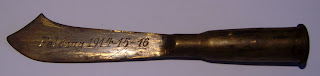
Historic paperknife, photo by Milgesch
       
     In this age of technological transformation, when I receive emails daily telling me about fancy new historical resources on-line, I’ve been reacquainting myself with a much older and more basic research tool – the knife. In the past two weeks, I have ordered up 5 1000-page volumes of 16C documents from the Bodleian, only to find that these squat pale books had uncut pages. When you point this out to the staff of the Upper Reading Room, they obligingly hand you a paper knife, although it’s blunt and rounded, and looks more like an early surgical implement or a metal shoe horn. Standing at the reserve counter for 20 minutes at a time, slicing at pages, is time-consuming and unexpectedly stressful. These books were mostly printed in 1950s’ Poland, when resources were rather scarce, and the paper is thin and low-grade, and easy to tear. You feel very exposed standing under the full glare of professional librarians, as your fellow readers and eminent colleagues come and go, hacking away, worried that at any moment in full view your hand will slip and you’ll slice right through a page, publically defacing an irreplaceable part of the Bodleian’s collections. It also feels illicit, in the near-silence of the library standing there quite noisily slashing through paper; usually, even tearing sheets out of my A4 pad in the Bod makes me nervous, because it sounds as if you’re vandalising the collections at your desk.

     It’s also rather sad that no-body has looked at these books since they were shipped from Poland in 1914, or 1956. You read the editors’ prefaces, in which they explain that they have painstakingly prepared these documents for publication, travelling to archives throughout Central Europe, interrupted by world wars, but pressing on regardless – for 10, 20 years. In light of all that effort, it’s rather melancholic to be the first person making use of these volumes, after almost a century lying dormant in the stacks. There is also, alongside that, a slight frisson when wielding the knife to be the first person to ever see the fresh pages of that particular copy, like cutting open a fruit.

     Perhaps the most curious thing about this whole exercise is that strictly speaking I don’t have to do it, because this entire 16C source collection is available on-line, courtesy of the Wielkopolska Digital Library. So it’s either a comment on my own stubborn ludditism, or on the shortcomings of electronic books, that I choose to take up my paper knife (so that I can access tangible physical pages to peruse at my desk), rather that sitting at my computer in college, scanning thousands of pages of sixteenth-century Latin on a screen for weeks on end. In the meantime, the staff have taken pity on me and sent my volumes to the Bodleian bindery at Osney Mead, where there is a magic machine which, they tell me, can cut the pages of a book in 30 seconds.

Tuesday, 22 November 2011

Tuning In


Alan Hollinghurst - recreating historical disorientation?
Photo by Nick Lansley

I’ve recently been reminded of Alan Hollinghurst’s The Stranger’s Child, the Booker-longlisted novel which I read over summer. The novel consists of 4 parts, set in different decades spanning from 1914 to the present-day. It’s a memorable read because Hollinghurst rather mercilessly drops his reader straight into a suburban drawing room (1914?), say, or a country house weekend party (the 1920s?) and into his characters’ conversations – about music, Cabinet politicians, minor public figures, or the latest trends in interior design. Because Hollinghurst doesn’t actually give us dates, the reader is left to flounder around like a time-traveller, guessing from the small-talk which year or century they have landed in. And unsurprisingly, a lot of the initial conversation in those scenes makes no sense at all at first, because it concerns the minutiae of a particular historical moment, and you have no reference points to hold onto.

I’m on research leave this term, and spending a lot of time in the Bodleian reading a massive collection of Polish 16C political correspondence called the Acta Tomiciana. Reading The Stranger’s Child is, in many ways, like forging your way through new source material as a historian. When you’re first dropped in with the documents, up close with the fine grain of the evidence and beyond the reach of existing textbooks or earlier published research, you’re swimming in an alien world where a lot of things are totally baffling. I found this as a graduate student first dipping my toes into late medieval Polish letter collections, like the Akta Aleksandra. Who are the Nohalsky Tartars the Polish elites keep talking about, and how do they relate to the Crimean Tartars also mentioned? If a letter is written on the octave of the feast of St. Cyril, what exactly does that mean? With the Acta Tomiciana, there are now new questions: who is the humble Mr. R in Rome, and why do Polish bishops write to him so often? Who is the Cardinal of the Four Saints? Who exactly is encompassed by the troubling enigmatic but commonplace phrase ‘the enemies of Christ’? But gradually, as with Hollinghurst’s novel, you tune in. You work out who the dramatis personae are, their concerns of the moment, and roughly where the story is going. Both Hollinghurst and the Acta Tomiciana have been a sobering reminder to me that before you can say insightful or new things about the past, you first have to work out what an earth is going on at ground level. But what Hollinghurst has done very effectively, and what we as historians sometimes struggle to do because we have tuned into our sources too well, is to convey the disconcerting alienness and bracing otherness of (even the recent) past.

Sunday, 9 October 2011

Seeing Double

This week, after years of work on the part of many people, the Kraków publishing house Societas Vistulana has published the Polish edition of my first book, which appeared in English in 2007. Translated by my Oxford colleague Tomasz Gromelski, Church, State and Dynasty in Renaissance Poland: The Career of Cardinal Fryderyk Jagiellon (1468-1503) has now become Królewski Kardynał. Studium Kariery Fryderyka Jagiellończyka (1468-1503).

Seeing the handsome blue-white-red cover of the Polish edition, initially in proofs and now on the Societas Vistulana website, has been exciting but also unexpectedly unsettling. When you’re writing a monograph, for months and months it exists just as a series of messy Word files on your computer (usually pock-marked with comments to yourself in bold typeface: ‘check this fact!’ ‘Where did I find this quote?’), but you think of it as a material object in waiting. The great moment, the moment when you know it really is finished, is when you tear open a brown cardboard package from your publishers and hold the gleaming book in your own hands. (Kindle et al may yet change this moment of epiphany, but I’m not so sure).

It’s therefore slightly strange when that same book, i.e. the text and its arguments, metamorphose and take on a second, alternative physical form – transposed into a different language, in the process becoming a different object, with a different physical appearance. Seeing the Polish edition has undermined my own (perhaps naïve) sense of the materiality of my book, perhaps betraying a Platonic assumption that it can have only one ultimate form. I’m going to put both covers on my college webpage – the appropriately Somervillian red and black of the Ashgate edition, with a woodcut of Fryderyk kneeling before Saint Stanisław, and the more abstract Polish cover, showing half of Fryderyk’s carved coat of arms bathed in an electric blue light. Now that the book exists in two parallel forms, it suddenly feels like a slippery, intangible thing again, as it was when it was just a series of Word documents on my computer. The artist Grayson Perry said in a television interview this week that there is, even in this digital age, a basic human need for the object, for its 'tangible, visceral experience'. Even when seeing double, with two books where once there was one, I think he's right.

Tuesday, 2 August 2011

Seeing is believing

The Enola Gay. Photo by Bernt Rostad.
After Bermuda, I ended up in Washington DC at the peak of a heat wave. One of the new museums, in that city of museums, to have opened up since I was last there is an extension of the Smithsonian Air & Space Museum, in a giant museum-hangar near Dulles Airport. This is where the aeronautical exhibits too big to fit in a regular city-centre museum are displayed – objects such as Concorde, for example, or the space shuttle Enterprise.

One of the most celebrated exhibits in the Stephen F. Udvar-Hazy Centre, however, is the Enola Gay. This huge silvery-shiny, gleaming machine is the aircraft which dropped the A-bomb on Hiroshima in August 1945, causing the deaths of between 118,000 and 140,000 people. As I hovered uncomfortably by the modest information board in front of the Enola Gay, three elderly Americans were clustered in front of it. The lady said: ‘You read about it, and that’s one thing, but to actually see it…’.

I initially thought this was quite a glib comment, but now I’m not so sure. It’s striking how journalists can report on major world events, and historians can make films and write books about them, but it’s only when presented with the physical evidence that they somehow become truly credible to a wider public. It’s as if we’re all semi-consciously suspending disbelief about the past events we read and write about, until they prove themselves to have had some material existence outside the text.

I don’t think professional researchers are immune from this kind of instinct. When I finished writing my doctorate, my husband bought me as a present two tiny coins minted in 15C Poland during the lifetime (and indeed the regency) of Cardinal Fryderyk Jagiellon, the churchman on whom I’d written my thesis. Once I had seen these little artefacts, I believed a little bit more in the existence of the late medieval world I had spent 3 years trying to reconstruct and recreate; and I hadn’t really been aware of not fully believing in it. Perhaps this is why historians are so resistant to the idea of being denied access to original sources in libraries, and directed to digitalised versions instead – the text shimmering on the screen, just like the text in printed reproduction, doesn’t feel as real as the cool leather and crisp, dry pages of a 15C early printed book. We seem to need the authentic, old material thing itself to fend away an involuntary suspension of disbelief about the past – even the well documented recent past of WWII. ‘You read about it but…’

Thursday, 21 April 2011

Paperwork


Bureaucratics: Reproduced with kind permission from Jan Banning
  While idly leafing through a UK national newspaper over my lunch this week, I saw a photograph which made me freeze in the middle of my bagel. It was from a project called Bureacratics, by the photographer Jan Banning, which is currently showing in a Dutch gallery, but which you can also see on-line or in book form (to see the full collection, click on Bureaucratics). To create Bureaucratics, Banning talked his way into hundreds of government offices across the world, from Yemen to Russia, and photographed bureaucrats at their desks.  He says that the project is “the product of an anarchist’s heart, a historian’s mind and an artist’s eye”.

The image which so struck me was a photograph of Sushama Prasad, assistant clerk at the Cabinet Secretary in Patna, India (above). This is a photo to induce a moment of horror in any historian. We see Ms. Prasad sat at a battered and bare desk, in front of large wooden cabinets. On top of these are piled hundreds upon hundreds of aged bundles of paper. They form a grey sea of unfiled, utterly chaotic, visibly decaying bureaucratic paperwork. This is precisely the sort of thing research historians see in bad dreams – sources there in tantalising abundance, yet virtually unusable, because they are utterly disordered and unsearchable. The sight of apparently rotting official papers, sources on the cusp of oblivion, is equally distressing – it reminded me of a Polish ecclesiastical archive in which I was handed 15C episcopal letters so damp, I had to wipe my hands after using them. Banning’s photograph brings home what historic documents look like in their ‘natural state’, if left to run wild like a garden. It makes stark too how much artifice and on-going human intervention there is behind an archive, where archivists have imposed (or maintained) an order on/in the paperwork. Ms. Prasad’s office, in this striking shot, is a kind of anti-archive, a dark place in the historian’s imagination.

Wednesday, 30 March 2011

The Text on the Table

In spite of the many inspiring libraries Oxford has to offer, I have increasingly found myself working in the various cafes around Somerville, now that term has finished and I’ve again been let loose on my research. If you’re researching, hermit-like all on your own, for hours a day, sitting in a public space where living people talk, come and go and drink tea gives you a surrogate kind of company, and a vicarious energy – even if (or perhaps especially if) you are reading texts written by people who have been dead for 500 years.

The text on the table:
 Peter Risinius against Johannes Hess (Cracow, 1524) 
But it also produces strange juxtapositions. Earlier this week, for example, I was reading an anti-Reformation polemic printed in Cracow in 1524, written by a very young Polish humanist (i.e. classical scholar) called Piotr Rydziński. He was writing against the group of intellectuals who had led a successful Reformation movement in Wrocław-Breslau – condemning Lutheran belief in colourful and sarcastic terms, while showing off his fancy Latin. Thanks to the digitalisation project of Wrocław Polytechnic in Poland, I didn’t have to travel to Central Europe to consult the original in a Rare Books Reading Room, but could sit in a café on Saint Giles reading and annotating a print-out I had downloaded earlier.

If you read a 16C book in the rarefied air of a research library, it’s easier to suspend disbelief; it’s almost as if you’re working in a timeless scholarly bubble, in a silent hall full of books. But once you take Rydziński’s Petri Risinii adversus Johannes Hessi into a café, and place the facsimile of the 1524 text on a little round table, next to a mug of mint tea and a cookie, under bright lights illuminating cakes and Italian baguette fillings, with cars and buses roaring past down Saint Giles, with catchy hits playing in the background, and dozens of people coming and going, the clash of worlds becomes acute. You become dizzyingly aware of the massive distance between Rydziński’s Cracow, at the start of the Reformation, and 21C Oxford – there is a jarring that libraries perhaps serve to protect us from. The aspiring young scholar who wrote the text on the café table in 1524 was desperately doing his bit to stop the old medieval Christendom from falling apart; it is endlessly strange that an elite religious text from his world can be casually read in a café by a layperson (and a woman at that), in a Europe which not only has the unimaginable permanent splitting of the Christian church been a fait accompli for half a millennium, but which has become in effect secularised, post-church. So it worries me a bit that Rydziński could not possibly have imagined my world in the cafe on Saint Giles; it makes me wonder how confident I can be about re-imagining his.