Dr. Natalia Nowakowska is Professor of European History at Somerville College, University of Oxford.


Friday, 2 December 2011

Knives in the Library

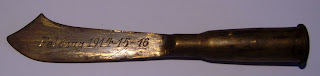
Historic paperknife, photo by Milgesch
       
     In this age of technological transformation, when I receive emails daily telling me about fancy new historical resources on-line, I’ve been reacquainting myself with a much older and more basic research tool – the knife. In the past two weeks, I have ordered up 5 1000-page volumes of 16C documents from the Bodleian, only to find that these squat pale books had uncut pages. When you point this out to the staff of the Upper Reading Room, they obligingly hand you a paper knife, although it’s blunt and rounded, and looks more like an early surgical implement or a metal shoe horn. Standing at the reserve counter for 20 minutes at a time, slicing at pages, is time-consuming and unexpectedly stressful. These books were mostly printed in 1950s’ Poland, when resources were rather scarce, and the paper is thin and low-grade, and easy to tear. You feel very exposed standing under the full glare of professional librarians, as your fellow readers and eminent colleagues come and go, hacking away, worried that at any moment in full view your hand will slip and you’ll slice right through a page, publically defacing an irreplaceable part of the Bodleian’s collections. It also feels illicit, in the near-silence of the library standing there quite noisily slashing through paper; usually, even tearing sheets out of my A4 pad in the Bod makes me nervous, because it sounds as if you’re vandalising the collections at your desk.

     It’s also rather sad that no-body has looked at these books since they were shipped from Poland in 1914, or 1956. You read the editors’ prefaces, in which they explain that they have painstakingly prepared these documents for publication, travelling to archives throughout Central Europe, interrupted by world wars, but pressing on regardless – for 10, 20 years. In light of all that effort, it’s rather melancholic to be the first person making use of these volumes, after almost a century lying dormant in the stacks. There is also, alongside that, a slight frisson when wielding the knife to be the first person to ever see the fresh pages of that particular copy, like cutting open a fruit.

     Perhaps the most curious thing about this whole exercise is that strictly speaking I don’t have to do it, because this entire 16C source collection is available on-line, courtesy of the Wielkopolska Digital Library. So it’s either a comment on my own stubborn ludditism, or on the shortcomings of electronic books, that I choose to take up my paper knife (so that I can access tangible physical pages to peruse at my desk), rather that sitting at my computer in college, scanning thousands of pages of sixteenth-century Latin on a screen for weeks on end. In the meantime, the staff have taken pity on me and sent my volumes to the Bodleian bindery at Osney Mead, where there is a magic machine which, they tell me, can cut the pages of a book in 30 seconds.

Tuesday, 22 November 2011

Tuning In


Alan Hollinghurst - recreating historical disorientation?
Photo by Nick Lansley

I’ve recently been reminded of Alan Hollinghurst’s The Stranger’s Child, the Booker-longlisted novel which I read over summer. The novel consists of 4 parts, set in different decades spanning from 1914 to the present-day. It’s a memorable read because Hollinghurst rather mercilessly drops his reader straight into a suburban drawing room (1914?), say, or a country house weekend party (the 1920s?) and into his characters’ conversations – about music, Cabinet politicians, minor public figures, or the latest trends in interior design. Because Hollinghurst doesn’t actually give us dates, the reader is left to flounder around like a time-traveller, guessing from the small-talk which year or century they have landed in. And unsurprisingly, a lot of the initial conversation in those scenes makes no sense at all at first, because it concerns the minutiae of a particular historical moment, and you have no reference points to hold onto.

I’m on research leave this term, and spending a lot of time in the Bodleian reading a massive collection of Polish 16C political correspondence called the Acta Tomiciana. Reading The Stranger’s Child is, in many ways, like forging your way through new source material as a historian. When you’re first dropped in with the documents, up close with the fine grain of the evidence and beyond the reach of existing textbooks or earlier published research, you’re swimming in an alien world where a lot of things are totally baffling. I found this as a graduate student first dipping my toes into late medieval Polish letter collections, like the Akta Aleksandra. Who are the Nohalsky Tartars the Polish elites keep talking about, and how do they relate to the Crimean Tartars also mentioned? If a letter is written on the octave of the feast of St. Cyril, what exactly does that mean? With the Acta Tomiciana, there are now new questions: who is the humble Mr. R in Rome, and why do Polish bishops write to him so often? Who is the Cardinal of the Four Saints? Who exactly is encompassed by the troubling enigmatic but commonplace phrase ‘the enemies of Christ’? But gradually, as with Hollinghurst’s novel, you tune in. You work out who the dramatis personae are, their concerns of the moment, and roughly where the story is going. Both Hollinghurst and the Acta Tomiciana have been a sobering reminder to me that before you can say insightful or new things about the past, you first have to work out what an earth is going on at ground level. But what Hollinghurst has done very effectively, and what we as historians sometimes struggle to do because we have tuned into our sources too well, is to convey the disconcerting alienness and bracing otherness of (even the recent) past.

Monday, 7 November 2011

Vera

It is very sad to write for a second time in less than six months about the premature death of a member of the Oxford community. I was working in the Bodleian’s Upper Reading Room (URR) this week, when I saw a notice announcing that one of the URR’s long-standing staff, Vera Ryhajlo, had died after a short battle with cancer.

I’ve been reading history books in the genteel surroundings of the URR – with its high ceilings, seventeenth-century friezes, walls lined with history journals – since I was an undergraduate, in the mid 1990s. As long as I can remember, Vera was there behind the Reserve Counter, jolly, larger than life, and always totally helpful and professional. If I had a complex photocopying order, involving dozens of forms and hundreds of pages of a nineteenth-century book, Vera would go patiently through the paperwork with me for half an hour, to ensure that the order was correct. Her laughter would carry through the reading room.

Historical research – as I’m being reminded this term, on sabbatical leave – is often a pretty lonely business, even in an apparently well peopled place like the URR. It’s just you, a stack of books and a clock, for months on end. For over 15 years, I’ve gone up the Reserve Counter, watched Vera hand over my books, and maybe come to her with a query if something went wrong with the electronic catalogue OLIS. It wasn’t until this week that I realised that, although my interactions with her were entirely about history books and often wordless, I find it hard to imagine the URR, my main research base throughout my career, without Vera. It reminded me, perhaps too late, that librarians humanise libraries (or dehumanise them in parts of the former Eastern bloc, but that’s another matter). I’ve sometimes written about communities here, but I had not realised until now that the URR is a community too – a community of people sitting silently at their desks, who by dint of the fact of being in a library don’t talk to each other, but a community nonetheless. It was a community which was made visible today, at Vera’s funeral at Saint Aloysius church in Oxford: academics, librarians, readers side by side in the pews. If you Google Vera’s name, you can see how many eminent historians and academics have fulsomely thanked her, and her colleagues David and Helen, in the prefaces to their books. In a community where books, and not speech, are the main method of interaction and communication, I hope that is an apt tribute.

Monday, 31 October 2011

Witches

1508 woodcut of witches
Photo by FrauBucher
I recently found myself in conversation with a small child in the run-up to Halloween. “What is a witch?” the child asked, “and where do they live?” As a history tutor who teaches the European witch-hunt for at least four separate Oxford undergraduate papers, I knew what the scholarly answer might be. A witch is early modern (and late medieval) Europe’s projection of its own ultimate imagined Other, the inversion of all the values that society most appreciated – a witch worshipped the Devil instead of God, engaged in sexual orgies in lieu of continence, killed cattle, made people sick and messed with the weather, rather than living as a useful member of the community. The witch was the infertile, jealous woman who poisoned infants, instead of the nurturing Christian mother. A witch was the parody of all that early modern Europeans believed held their fragile world together. (You can read about all this, for example, in Witch Craze, by Oxford's new Regius Professor, Lyndal Roper).

Instead of saying that, I said: “A witch is a woman who rides through the sky on a broomstick.” And because of the Polish elements in my upbringing, on the question of place of abode I went on to say: “She lives on Lysa Góra (Bald Mountain), with her friends.” There is a popular Polish nursery rhyme that goes: ‘There once was a witch who lived in a hut made of butter, and that hut was full of wonders…’ I was a bit surprised that, put on the spot, I gave this 21C child a 16C definition of witchcraft, which could have been straight from the pages of a demonological treatise (albeit with the more graphic details excised). Was it because I thought the 16C answer would be more comprehensible to a three-year old than the 21C answer? (I did add that witches could be men too, and that they are not real, as concessions to modernity). But this conversation did bring home to me this Halloween that, however much historians analyse and research and deconstruct, certain elements of early modern culture do live on, stubbornly and surprisingly, in our own, and we too transmit and preserve and hand down that culture, if only in our oral and story-telling traditions. And interestingly, when the child then pointed and said: “I can see a witch walking on the roof of your house” I was, half a millennium after the European witch-hunt and after decades of brilliant modern witchcraft scholarship, a little bit spooked.

Friday, 21 October 2011

Urban Dislocation

This week I finished reading The Last Hundred Days by Patrick McGuinness, who as well as being a poet and (with this novel) Booker long-listed author is also Professor of French Literature at Oxford. This possibly partially autobiographical book is about a drifting young Brit who finds himself in Ceausescu’s Romania during what transpires to be the regime’s endgame in 1989. The Last Hundred Days is probably the best evocation of life under Communism I’ve read since Marian Brandys’ memoir Moje Przygody z Historią (‘My Adventures with/in History’), which I read, I have to admit, for my Polish A-Level.

McGuinness wonderfully evokes a Bucharest in which the boundaries between space and time have become strangely fluid, as the regime tears down belle époque villas and medieval monasteries in order to erect in their place an ‘Stalinist legoland’. At its centre point is the Palace of the People – as the character Leo declares, “When they’ve finished building it, the whole of communism will climb in there, shut the doors, and die.” The pace of urban vandalism is so fast that the characters are regularly lost. As they wander around 1980s’ Bucharest at night armed with 1920s’ maps, they stumble upon people dancing to accordion and fiddler music by lamplight, or deserted nineteenth-century palazzos, unsure if they have accidentally crossed over into an earlier century, or an eternal Bucharest living in the gaps between past and present.

I was thinking about The Last Hundred Days during the Long Vacation, when I turned into Saint Giles and had my own experience of stunning urban dislocation. That long thoroughfare of buses, trees and college buildings had become a kilometre long traffic-free fairground, packed with people pushing buggies, kids holding bags of cotton candie, and the most extraordinary rides – a 3 storey high ghost train erected right against the façade of the Humanities Division, a twister which sent screaming teenagers hurtling within feet of the dour face of Saint John’s college, and a ride which shot people up into the sky higher over the spire of the Martyrs' Memorial. This subversive spectacle reminded me of early modern carnivals, when authorities and dominant institutions were mocked and riotous fun ruled the streets – the world turned (literally for the riders) upside down. It felt like crossing into an alternative Oxford.

Sunday, 9 October 2011

Seeing Double

This week, after years of work on the part of many people, the Kraków publishing house Societas Vistulana has published the Polish edition of my first book, which appeared in English in 2007. Translated by my Oxford colleague Tomasz Gromelski, Church, State and Dynasty in Renaissance Poland: The Career of Cardinal Fryderyk Jagiellon (1468-1503) has now become Królewski Kardynał. Studium Kariery Fryderyka Jagiellończyka (1468-1503).

Seeing the handsome blue-white-red cover of the Polish edition, initially in proofs and now on the Societas Vistulana website, has been exciting but also unexpectedly unsettling. When you’re writing a monograph, for months and months it exists just as a series of messy Word files on your computer (usually pock-marked with comments to yourself in bold typeface: ‘check this fact!’ ‘Where did I find this quote?’), but you think of it as a material object in waiting. The great moment, the moment when you know it really is finished, is when you tear open a brown cardboard package from your publishers and hold the gleaming book in your own hands. (Kindle et al may yet change this moment of epiphany, but I’m not so sure).

It’s therefore slightly strange when that same book, i.e. the text and its arguments, metamorphose and take on a second, alternative physical form – transposed into a different language, in the process becoming a different object, with a different physical appearance. Seeing the Polish edition has undermined my own (perhaps naïve) sense of the materiality of my book, perhaps betraying a Platonic assumption that it can have only one ultimate form. I’m going to put both covers on my college webpage – the appropriately Somervillian red and black of the Ashgate edition, with a woodcut of Fryderyk kneeling before Saint Stanisław, and the more abstract Polish cover, showing half of Fryderyk’s carved coat of arms bathed in an electric blue light. Now that the book exists in two parallel forms, it suddenly feels like a slippery, intangible thing again, as it was when it was just a series of Word documents on my computer. The artist Grayson Perry said in a television interview this week that there is, even in this digital age, a basic human need for the object, for its 'tangible, visceral experience'. Even when seeing double, with two books where once there was one, I think he's right.

Tuesday, 4 October 2011

Treasures of Heaven


Missing Relic?
The Crown of Saint Stephen of Hungary

This weekend, I went to the British Museum's exhibition Treasures of Heaven: Relics and Devotion in Medieval Europe (which closes this week, on Oct 9th). The exhibition has been very positively reviewed in the British and American press (it showed in the US earlier in the year). The sheer array and number of reliquaries on display is certainly impressive - if you like peering into display cases in a darkened hall with atmospheric 13C music playing in background, admiring the aesthetics of medieval goldsmithery, enamel, ivory-carving and wood polychrome, this is certainly an exhibition for you. On the whole, though, I wasn’t sure it amounted to much more than the sum of its parts – it felt a like an attempt to amass a huge collection of relics under one roof for its own sake, not unlike a modern museum version of the
relic-collecting medieval rulers featured in the show.

What particularly troubled me as a historian about this exhibition, however, was the ‘Medieval Europe’ claim in the title. The exhibition catalogue opens with a glossy but shocking map of ‘Medieval Europe’, a map which labels key places in Western Europe and the Byzantine world, leaving Catholic Eastern Europe totally blank, as if it were one big tract of uninhabited forest. It’s a map straight out of the Cold War. Were there no relics in medieval Budapest, Cracow or Vilna? What about Hungary’s most precious relic, the Crown of Saint Stephen, or the head of Poland’s Saint Stanislaw in its fabulous 1504 gold casket, or the celebrated 1388 ‘Elbląg’ diptych reliquary made for the Teutonic Knights in Prussia? The reliquaries on display in Treasures of Heaven come chiefly from the collections of the British Museum, the Cleveland Museum of Art and the Walters Art Museum in Baltimore – if those collections, for historic reasons, feature overwhelmingly west European and Byzantine artefacts, it’s important to explain that as such they are not necessarily representative of medieval Christianity as a whole. In the catalogue, the curators thank international colleagues and museums who had assisted the exhibition – institutions in France, Germany, Italy and (one South-East European example) Bulgaria. One wonders if curators in Hungary, Poland and the Baltic states simply didn’t pick up the phone, or whether they were not asked, because it’s still – in spite of all we know – ok to view medieval Europe through a twentieth-century geopolitical lens.